Written by Professor Vik Veer, Consultant ENT & Sleep Surgeon · Published · Last reviewed
Quick Summary
- The short answer. Snoring without sleep apnoea is probably not harmless, but the harm that has actually been demonstrated is local damage to the throat rather than proven heart attacks or strokes.
- Vibration injury. Palate muscle removed at surgery from snorers shows nerve damage and partial regrowth, with roughly a third of the normal density of nerve fibres.
- Loss of sensation. Snorers have measurably reduced feeling in the soft palate — and the longer they have snored, the worse it is. Sensation in the lip, which does not vibrate, is normal.
- Silent swallowing changes. X-ray swallowing studies found abnormalities in around half of snorers versus 7 per cent of non-snorers, including in those with an AHI below 5. None had noticed a problem.
- It gets worse if untreated. Over six to seven years, untreated snorers lost substantial palatal sensation and their AHI doubled. CPAP-treated patients did not deteriorate at all.
- Progression to apnoea. Plausible and commonly seen in clinic, but not proven. Weight gain and age remain the best-established drivers.
- The arteries. Vibration damages the carotid artery lining in animal studies without any drop in oxygen, and heavy snorers have thicker carotid walls — but the one long-term objective human study found no excess deaths, heart attacks or strokes.
- Children. In the PATS randomised trial, removing tonsils and adenoids from snoring children improved behaviour, sleepiness, quality of life and blood pressure, and cut progression to sleep apnoea from 13 per cent to about 1 per cent.
- What to do. Treat snoring as a symptom that deserves assessment, including a sleep study. A normal study from ten years ago is not a permanent all-clear.
"Simple" Snoring — and Why I No Longer Use That Word
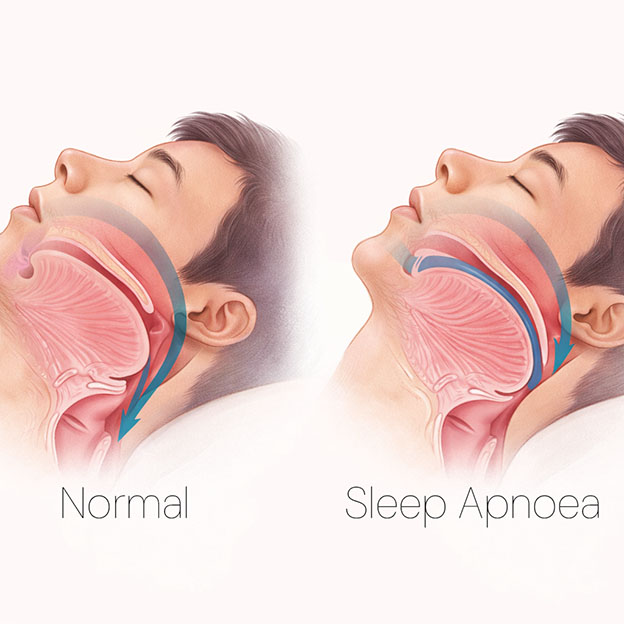
Snoring without sleep apnoea has traditionally been labelled "simple snoring": a nuisance for your partner, but no harm to you. That is what I was taught, and it is still what many patients are told after a normal sleep study. I no longer think it is the whole story, and a growing number of researchers agree.
Sleep apnoea means the airway repeatedly narrows or closes during sleep, so that breathing stops or becomes very shallow. It is measured with the apnoea-hypopnoea index (AHI), the number of those events per hour of sleep. Snoring without significant apnoea, sometimes called primary snoring, is the subject of this page. If you are not sure which of the two you have, the snoring versus sleep apnoea page explains how they are told apart. The harms of sleep apnoea itself are covered on the OSA and your health pages, and the wider question of snoring's effect on blood pressure, glucose handling and daytime alertness is reviewed on is snoring bad for you?
A word on the evidence
Many of the headline figures you will see about snoring come from questionnaires, where people are simply asked whether they snore. Those studies cannot tell a snorer from someone with undiagnosed sleep apnoea, so they tend to overstate the risk of snoring on its own. On this page I have leaned on studies that measured snoring properly or examined the throat directly, and I have flagged where the numbers are small or the findings contradict each other.
Vibration Injury: The Throat's Version of Vibration White Finger
Workers who spend years using pneumatic drills, grinders or chainsaws can develop hand-arm vibration syndrome, sometimes called vibration white finger. Constant low-frequency vibration damages the small nerves and blood vessels in the hands, causing numbness, tingling and loss of grip. A snoring soft palate vibrates for several hours every night, often for decades, and in the 1990s researchers at the Karolinska Institute in Stockholm proposed that it might suffer a similar injury. The idea has been tested repeatedly since.
When surgeons have examined the palate muscle removed during snoring operations, the findings have been consistent. Compared with non-snorers, the muscle shows a pattern typically seen when its nerve supply has been damaged and has partly regrown.[1] The nerves themselves have roughly a third of the normal density of nerve fibres, and many show signs of degeneration and attempted repair.[2] Similar changes are seen in heavy snorers without significant sleep apnoea as in people with it.[3]
Sensation in the soft palate is reduced in snorers compared with non-snorers, while sensation in the lip, which does not vibrate, is normal. The longer someone has snored, the worse their palate sensation tends to be.[4] X-ray studies of swallowing found subtle swallowing problems in around half of snorers, compared with 7 per cent of non-snorers, and this was true even in snorers with an AHI below five, the usual threshold for diagnosing sleep apnoea.[5] None of these people had noticed any difficulty swallowing.
When the throats of rats were vibrated at a frequency typical of snoring for three hours, with nothing else changed, the tissue of the soft palate began producing inflammatory chemicals.[6] Human airway cells vibrated in a dish do the same, which points to the vibration itself as the cause.
Evidence flag: Most of these human studies include 20 to 40 patients, and the tissue comes from people already having throat surgery, who are not typical of snorers in general. The findings are consistent across different research groups, which is reassuring, but they show an association rather than proof that snoring caused the damage.
"I recently had the privilege of seeing Professor Vik Veer regarding long-standing snoring and airway concerns, and I can honestly say the experience exceeded my expectations. From the outset he was welcoming, approachable and even gently humorous, which immediately put me at ease — yet the consultation itself was thorough, focused and highly professional. He carried out a detailed examination, explained the anatomy clearly, and outlined a structured, logical plan for moving forward. Nothing felt rushed, dismissed or oversimplified. I left feeling reassured, better informed, and confident that there is now a clear pathway ahead. After a long period of uncertainty, that clarity meant a great deal." Google Review, 5 stars — John Lewin
Does the Damage Get Worse With Time?
Svanborg and colleagues in Sweden followed snorers for six to seven years.[7] The researchers measured how cold a probe on the soft palate had to become before people could feel it, which is a simple test of nerve function. In 25 people who carried on snoring without treatment, the palate went from detecting a temperature change of around 4°C to needing a change of around 11°C, a substantial loss of sensation. Over the same period, their AHI doubled from a median of 7 to 14 events per hour. Non-snorers lost far less sensation with ageing, and a group of patients using CPAP (a mask that keeps the airway open with air pressure, which also stops snoring) did not deteriorate at all, which suggests that once the vibration stops, so does the decline.
Evidence flag: This is one study of 25 untreated snorers. The loss of sensation and the rise in AHI happened in the same group, but in individual patients the two did not move together, so the study cannot show that one caused the other.
Can Snoring Turn Into Sleep Apnoea?
In clinic I hear the same story from a lot of patients. They have snored for many years. At some point they had a sleep study, which was normal, and they were told their snoring was harmless. Years later, their partner starts noticing pauses in their breathing, or they become more tired during the day, and a repeat study now shows sleep apnoea. Some of these patients have put on weight in between, but not all of them.
People whose snoring stays harmless have no reason to come back and see me, so the patients I meet are, by definition, the ones who got worse, and my impression is anecdote rather than data. Even so, it happens often enough that I no longer regard a normal sleep study from ten years ago as a permanent all-clear.
In another Swedish study, of men with snoring and daytime sleepiness, the number with sleep apnoea rose from 4 of 29 to 13 of 29 over ten years.[8] Needle recordings of the electrical activity in the palate muscles found clear signs of nerve damage in 10 of 12 people with sleep apnoea, but in only 3 of 15 habitual snorers.[9] That pattern would fit a gradual process, where nerve damage builds up over years of snoring until the muscles can no longer hold the airway open at night.
Evidence flag: The idea that vibration damage causes sleep apnoea has not been proven. The best-established drivers of worsening are weight gain and age: in one study of 160 men, those were the only factors that predicted a rising AHI.[10] It also works the other way round, because the repeated collapse of the airway in sleep apnoea injures the same tissues. My own view is that snoring is both a warning sign and, over many years, probably a contributor, but that remains a hypothesis rather than an established fact.
"It was wonderful to finally have confirmation that I do have a sleep disorder and that action is necessary! I now feel confident that Mr Veer can improve my sleep and, as a result, improve my life." Google Review, 5 stars — Felicity Knapton
Snoring and the Arteries in the Neck
The carotid arteries, which supply the brain, run a short distance from the vibrating tissues of the throat. In anaesthetised rabbits, snoring vibration can be measured in the wall of the carotid artery and inside it.[11] When rabbit carotid arteries were exposed to snoring-level vibration for six hours, without any drop in oxygen levels, the lining of the artery stopped working normally, and the effect was greater with stronger vibration.[12] Damage to this lining is one of the earliest steps in furring of the arteries.
In people, a study of young and middle-aged adults without sleep apnoea found that heavy snorers had thicker carotid artery walls than light snorers, even after allowing for blood pressure, weight, cholesterol and diabetes.[13]
But the only long-term community study to measure snoring objectively found no link between snoring and death, heart attacks or strokes over 17 years.[14] That study included only 380 people, and its authors acknowledge that it could not rule out a small effect. The mechanism is plausible and the early findings in the arteries are real, but nobody has yet shown that snoring on its own causes strokes or heart attacks. The picture is entirely different once sleep apnoea is present, where the link with heart disease and stroke is well established.
Snoring in Children
Children who snore are the one group in whom treatment has been tested in a randomised trial, where patients are allocated to treatment or no treatment by chance. In the PATS trial, 459 children aged 3 to 12 who snored but did not have significant sleep apnoea either had their tonsils and adenoids removed or were watched and supported without surgery.[15]
After a year, surgery made no difference to the two main outcomes, which were tests of attention and executive function (the mental skills of planning, self-control and organisation). It did improve behaviour, daytime sleepiness, quality of life and blood pressure. It also reduced progression to sleep apnoea: 13 per cent of the untreated children developed it within the year, compared with around 1 per cent of those who had surgery. A later analysis found the operated children needed about a third fewer visits to doctors over the year.[16] More on this is on the children's behaviour and learning page, and on the paediatric ENT page.
What This Means If You Snore
Not every snorer needs an operation, but snoring deserves to be taken seriously as a medical symptom rather than dismissed as a nuisance. If you have snored for years, it is worth having it assessed properly, including a sleep study to look for sleep apnoea.
If you had a normal sleep study some time ago, I would consider repeating it if your snoring has become louder, your partner has noticed pauses in your breathing, you have gained weight, or you are more tired during the day than you used to be.
Apart from the CPAP finding above, there is no good evidence yet that treating snoring in adults prevents the nerve damage or reduces the risk of later problems. That is the obvious next research question. In the meantime, treatment options range from throat exercises and positional therapy to nasal surgery and palate surgery, and the right choice depends on where in the airway the snoring comes from — which is what sleep endoscopy is designed to establish. The treatments page sets out the full range of options, and the snoring and sleep apnoea overview is the best place to start if this is all new to you.
Professor Vik Veer’s step-by-step guide to how snoring and sleep apnoea are assessed and treated — from working out where the noise comes from to what each treatment can realistically achieve.
"Dr Veer has helped me over the last few months identify my sleep apnoea with a home sleep study and endoscopy. My AHI was 24 prior to using CPAP and 15 after using. After using the techniques he recommended, it has fallen to 1!" Google Review, 5 stars — Peter Hurley
References
- Friberg D, Ansved T, Borg K, Carlsson-Nordlander B, Larsson H, Svanborg E. Histological indications of a progressive snorers disease in an upper airway muscle. American Journal of Respiratory and Critical Care Medicine. 1998;157(2):586–593. Palatopharyngeus biopsies, 21 snorers (10 with OSA) vs 10 non-snoring controls; neurogenic changes increased with degree of obstructive breathing.
- Shah F, Franklin KA, Holmlund T, et al. Axon and Schwann cell degeneration in nerves of upper airway relates to pharyngeal dysfunction in snorers and patients with sleep apnea. Chest. 2018;154(5):1091–1098. 22 patients vs 12 controls; axon density 5.4 vs 17.9 × 10⁻³ per μm²; lower density associated with swallowing dysfunction.
- Woodson BT, Garancis JC, Toohill RJ. Histopathologic changes in snoring and obstructive sleep apnea syndrome. Laryngoscope. 1991;101(12):1318–1322. 4 severe apnoeics, 4 severe snorers, 4 non-snorers; similar tissue changes in snorers and apnoeics.
- Sunnergren O, Broström A, Svanborg E. Soft palate sensory neuropathy in the pathogenesis of obstructive sleep apnea. Laryngoscope. 2011;121(2):451–456. 25 non-snorers, 32 snorers (AHI <10), 33 OSA; palatal sensation correlated with duration of snoring (r = 0.47); lip sensation unaffected.
- Levring Jäghagen E, Nilsson ME, Isberg A. Snoring, sleep apnoea and swallowing dysfunction: a videoradiographic study. Dentomaxillofacial Radiology. 2003;32(5):311–316. Pharyngeal swallowing dysfunction in 52% of 66 snorers vs 7% of 15 controls; 43% in those with AHI <5.
- Almendros I, Acerbi I, Puig F, Montserrat JM, Navajas D, Farré R. Upper-airway inflammation triggered by vibration in a rat model of snoring. Sleep. 2007;30(2):225–227. 60 Hz vibration for 3 hours; TNF-alpha expression increased around six-fold in soft palate tissue.
- Svanborg E, Ulander M, Broström A, et al. Palatal sensory function worsens in untreated snorers but not in CPAP-treated sleep apnea patients, indicating vibration-induced nervous lesions. Chest. 2020;157(5):1296–1303. Prospective, 6 to 7 year follow-up; 25 untreated snorers, 21 non-snorers, 19 CPAP-treated patients.
- Lindberg E, Elmasry A, Gislason T, et al. Evolution of sleep apnea syndrome in sleepy snorers: a population-based prospective study. American Journal of Respiratory and Critical Care Medicine. 1999;159(6):2024–2027. 29 untreated men; OSA (AHI ≥5) increased from 4 to 13 over 10 years.
- Svanborg E. Impact of obstructive apnea syndrome on upper airway respiratory muscles. Respiratory Physiology & Neurobiology. 2005;147(2–3):263–272. Concentric needle EMG of palatopharyngeus; neuropathic findings in 10 of 12 OSA patients and 3 of 15 habitual snorers.
- Berger G, Berger R, Oksenberg A. Progression of snoring and obstructive sleep apnoea: the role of increasing weight and time. European Respiratory Journal. 2009;33(2):338–345. 160 untreated men with two sleep studies a mean of 5 years apart; change in BMI and time were the only significant predictors of AHI change.
- Amatoury J, Howitt L, Wheatley JR, Avolio AP, Amis TC. Snoring-related energy transmission to the carotid artery in rabbits. Journal of Applied Physiology. 2006;100(5):1547–1553.
- Cho J-G, Witting PK, Verma M, et al. Tissue vibration induces carotid artery endothelial dysfunction: a mechanism linking snoring and carotid atherosclerosis? Sleep. 2011;34(6):751–757. Rabbit model; hypoxia and pressure swings prevented; dose-dependent endothelial dysfunction.
- Taylor CN, Hanna DB, Redline S, et al. Snoring severity is associated with carotid vascular remodeling in young adults with overweight and obesity. Sleep Health. 2021;7(2):161–167. 122 adults; objectively measured snoring; non-OSA heavy snorers had greater carotid intima-media thickness than non-OSA light snorers after adjustment.
- Marshall NS, Wong KKH, Cullen SRJ, Knuiman MW, Grunstein RR. Snoring is not associated with all-cause mortality, incident cardiovascular disease, or stroke in the Busselton Health Study. Sleep. 2012;35(9):1235–1240. 380 adults, objective snoring measurement, 17 years' follow-up; no association found; study underpowered for small effects.
- Redline S, Cook K, Chervin RD, et al. Adenotonsillectomy for snoring and mild sleep apnea in children: a randomized clinical trial. JAMA. 2023;330(21):2084–2095. PATS trial; 459 children aged 3 to 12.9 with snoring and obstructive AHI <3; progression to AHI >3 in 1.3% after surgery vs 13.2% with watchful waiting.
- Bakker JP, Wang R, Chervin RD, et al. Adenotonsillectomy and health care utilization in children with snoring and mild sleep apnea: a randomized clinical trial. JAMA Pediatrics. 2025. 32% fewer health care encounters and 48% fewer prescriptions over 12 months after surgery.
Contact Professor Vik Veer
If you would like to discuss a snoring assessment or arrange a consultation, please use the details below.
Private secretary: 0207 458 4584
Email: secretary@consultant-surgeon.co.uk
Page created 20th September 2026 by Professor Vik Veer, Consultant ENT & Sleep Surgeon, 150 Harley Street, London. This page is patient education and does not replace individual medical assessment. Patient comments are genuine published reviews; individual results vary.