Sleep Deprivation in High-Risk Professions
Two surgeons are scrubbing in for an emergency ruptured aortic aneurysm operation at two in the morning. This is the kind of case where the margin between a good outcome and a catastrophic one is measured in careful decisions. Both surgeons are qualified. Both are experienced. Both, on paper, are fit to operate. One has just finished a run of night shifts and has slept, fitfully, in the hours between. The other has been on a day rota and went home to rest at their normal sleep time. Who would you rather operate on you or a family member?
We do not and cannot tell them apart by just looking at them. The hospital does not distinguish between them on the rota. The regulatory framework does not ask. We simply assume that the one who has clocked enough hours off duty is cognitively equivalent to the one who slept well. This assumption is not only wrong. It is, as the evidence increasingly makes clear, a form of institutionalised optimism that we have embedded so deeply into our safety cultures that we have stopped noticing it is there. For many of these sleep-deprived workers, undiagnosed obstructive sleep apnoea is compounding the problem — and seeking assessment from an obstructive sleep apnoea specialist London is often the first step toward identifying it.
"Prof Vik Veer is one the nicest most personable, friendly and obviously very clever people I've met in the medical field. He has given me the validation and time that others haven't, and answers to what I suspected was already wrong with me. Please go and see him for any issues you have. He clearly wants to empower his patients with as much information as he can." Google Review, 5 stars — K P B
Sleep is not a flat line
The first and most important thing to understand about sleep, spectacularly ignored by shift schedulers across virtually every high-risk industry, is that it is not a uniform constant state. It is a structured biological phased programme, and the order in which it runs matters enormously.
In the first half of a normal night, the brain spends the majority of its time in deep, slow-wave sleep: what sleep scientists call N3. This is not simply rest. During N3, the brain activates the glymphatic system, a recently discovered network of fluid channels that flushes toxic metabolic waste products from neural tissue. Chief among the substances cleared are amyloid-beta and tau: the proteins whose accumulation we associate with Alzheimer's disease. Adenosine, the chemical that builds up with every hour of wakefulness and drives the sensation of sleepiness, is also cleared during this process. In animal models, glymphatic clearance during sleep is roughly twice as fast as during waking hours. In a landmark 2026 randomised crossover trial in humans, researchers confirmed that a single night of sleep deprivation measurably impaired this clearance process and that the effects were not fully reversed by subsequent recovery sleep [Hablitz LM et al. Nature Communications. 2026].
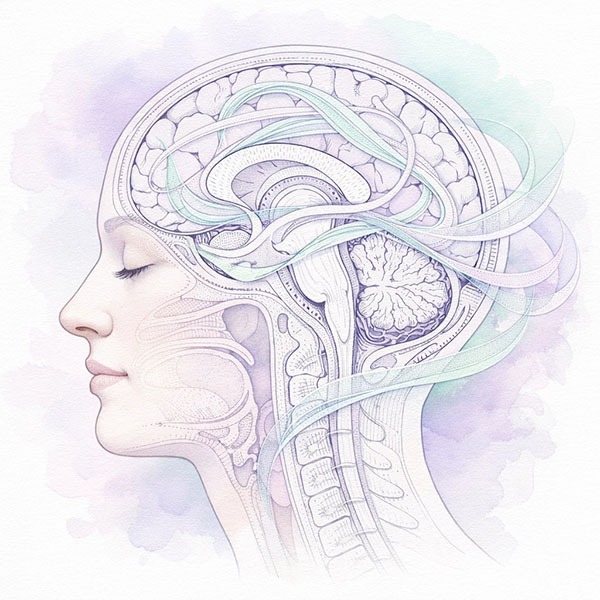
In the second half of the night, the balance shifts. REM sleep (rapid eye movement, dreaming sleep) becomes progressively dominant. REM is not the brain idling; it is the brain consolidating emotional memories, processing threat responses, and essentially filing the experiences of the day into long-term storage. Disrupt REM and you impair emotional regulation, increase reactivity, and blunt the capacity for the kind of measured, analytical reasoning that distinguishes a considered clinical decision from a snap one.
Truncate sleep at either end, as shift patterns almost universally do, and you lose distinct, non-recoverable functions. There is no menu option that allows you to keep the bits you need for work and discard the rest. It comes as a set. The same disruption occurs nightly for the estimated one in four adults whose snoring and sleep-disordered breathing goes undiagnosed and untreated.
The human circadian rhythm runs, on average, on a cycle of approximately 24.2 hours. It is anchored by light exposure, social cues, meal timing and temperature. Shift workers, operating at hours misaligned with this internal clock, are not simply tired in the ordinary sense. They are asking their brains to function at a phase the body has actively prepared for sleep. This is a meaningfully different biological state, and no quantity of strong coffee will bridge this gap.
Who is actually sleeping like this?
The honest answer is: rather a lot of the people we rely upon most.
Take HGV drivers. A peer-reviewed study of 329 UK long-distance lorry drivers, using objective wrist actigraphy over eight days, found that 58 per cent averaged fewer than six hours of sleep per 24-hour period. Ninety-one per cent fell short of seven hours. Driver fatigue is implicated in approximately 20 per cent of road fatalities, 30 per cent of serious crashes, and 60 per cent of minor road incidents. The tachograph records driving time. It does not record whether the sleep in between was restorative N3-rich sleep or four fragmented hours in a cab layby, which is a somewhat important distinction when you are piloting 44 tonnes down a motorway at night [Sargent C et al. Occupational & Environmental Medicine. 2021].
The submarine story is, if anything, more instructive. For 45 years, the United States Navy operated its submarine crews on an 18-hour day. Sailors stood six hours of watch, then had 12 hours for maintenance, training and sleep. The organisational logic was that without natural light, the normal 24-hour day was irrelevant. Researchers disagreed. Melatonin studies found that the endogenous circadian rhythms of submariners remained stubbornly anchored to a 24.35-hour cycle regardless of the imposed schedule. The bodies simply did not adapt. The result was chronic circadian misalignment, documented fatigue, and officers literally being slapped awake at their posts during surveillance watches. The US Navy moved to a 24-hour schedule in 2014. Morale improved dramatically. Vigilance failures dropped. It took nearly half a century to make this change [Shattuck NL, Matsangas P. Ergonomics. 2016].
In medicine, the picture is more complicated and arguably more uncomfortable, because we are the ones writing the prescriptions for other people while running the same deficit ourselves. Before the European Working Time Directive came into force for doctors in 2004, junior doctors regularly worked shifts in excess of 100 hours per week. The EWTD was a necessary correction. Reducing doctors' hours from that extreme was unambiguously the right thing to do.
The problem was what came next. Compliance with the 48-hour average working week was achieved largely by converting on-call cover into shift-based rotas. The shift patterns that resulted frequently included blocks of seven consecutive night shifts, identified in the sleep science literature not as a safe working pattern but as the worst-performing one. Risk of error increases exponentially over consecutive nights. Circadian rhythms show minimal adjustment even after a full week of nocturnal working, because daytime sleep is structurally inferior to night sleep: shorter, lighter, and deficient in the N3 slow-wave phases that do the neural maintenance. The regulations reduced the total hours worked while simultaneously introducing a pattern of circadian disruption that may, in certain configurations, be comparably damaging. We solved the quantity problem and created a quality problem [Landrigan CP et al. NEJM. 2004].

Across the other professions, air traffic controllers, armed forces personnel, police, oil rig workers, airline pilots, variations of the same theme recur. Schedules are designed around operational requirements and regulatory minimums, with sleep architecture an afterthought at best. The aviation sector has moved furthest, mandating crew rest periods with genuine legislative teeth. It remains telling that the pilot's rest schedule is regulated with more precision than the surgeon's or the submariner's.
What actually degrades, and why it matters that you cannot tell
Sleep deprivation does not produce an even decline across all cognitive functions. It attacks in a particular order, and the order is worth knowing.
Sustained vigilance is the first casualty: the ability to maintain alertness and catch subtle signals over time. This is precisely the capacity most needed for assessing risk in a patient's observations, watching a radar screen, or driving through the small hours on a quiet road. It is also the capacity most likely to be preserved on short, motivating tasks, which is why sleep-deprived workers often feel, and indeed briefly perform, as though they are fine. They are not fine. They are fine on the easy bits.
Executive function, the capacity to weigh competing options, reason through novel problems, and apply deliberate analytical thought, degrades next. This is replaced, progressively, by a shift towards fast, emotional, heuristic decision-making. The sleep-deprived surgeon is more likely to go with instinct than evidence; more likely to dismiss an anomaly than investigate it; more likely to become irritable under challenge and to interpret that irritability as justified certainty rather than physiological noise. The prefrontal cortex is the seat of measured reasoning and is exquisitely sensitive to sleep loss. The amygdala, which drives fear and threat responses, is not.
The most structurally alarming aspect of all this is not the impairment itself but the metacognition, or rather, the absence of it. Sleep-deprived individuals consistently and systematically underestimate their own impairment. A landmark study by Williamson and Feyer established that moderate sleep deprivation produces cognitive and motor impairments equivalent, in performance terms, to a blood alcohol level at or above the legal driving limit. A person would not claim to be unaffected by that quantity of alcohol. They would, after four to six hours of disrupted sleep, frequently make exactly that claim [Williamson AM, Feyer A-M. Occupational and Environmental Medicine. 2000].
The people least equipped to judge whether they are fit to make a life-and-death decision are, by definition, the most sleep-deprived ones.
The Working Time Directive: right diagnosis, botched prescription
It would be unfair to characterise the EWTD as a failure. It was not. It ended a culture in which junior doctors were expected to work through states of impairment that would not have been tolerated in any other safety-critical profession, and it did so with the force of law rather than the force of gentle suggestion. That was necessary and overdue.
What it did not do was engage with the biology of sleep architecture. It counted hours. Hours are the right starting point. They are not, on their own, sufficient. A rota that delivers 48 hours of work per week across seven consecutive night shifts, with daytime sleep in between, is not biologically equivalent to a rota delivering the same number of hours on a stable, circadian-aligned schedule. The former is, by the evidence, substantially more cognitively disruptive. The regulations met the letter of the law on hours. They did not meet the biological point.
The evidence on what actually works is not obscure. Rotating shifts perform better when they move clockwise (morning to afternoon to night) because this mimics natural phase delay and is better tolerated by the circadian system than the reverse. Consecutive night shifts should be kept to a maximum of three; a single night shift with a full day off on either side is the least circadian-disruptive pattern possible. Minimum off-duty periods between shifts should be long enough to guarantee seven hours of actual sleep, not merely the opportunity for it, which requires accounting for commute time and the physiological difficulty of sleeping during the day. Strategic naps of 20 to 45 minutes during night shifts have documented benefits for vigilance and performance. None of these are radical ideas. They are the consensus recommendations of occupational sleep medicine, and they are inconsistently applied.
The question we are not quite asking
Return to the choice between those two surgeons. The emergency is under way. The anaesthetist is running the ventilator. The scrub nurse is handing instruments. The registrar is watching the field. The surgeon is making decisions in real time, under pressure, with a fatigued prefrontal cortex and an adenosine-saturated brain, in the early hours of the morning.
The framework that put them in that situation, the rota, the directive, the hospital scheduling system, was not designed to harm anyone. It was designed to meet regulatory requirements as efficiently as possible, within existing staffing, at minimum cost. These are not unreasonable constraints. They are, however, constraints that were applied without a serious institutional reckoning with sleep biology. We built the rotas. We wrote the regulations. We should at least be honest that we did so with our eyes open.
Employers have a legal duty to manage fatigue as a safety-critical hazard. The Health and Safety Executive is explicit: compliance with Working Time Regulations alone is insufficient to manage the risks of fatigue. The gap between what the regulations require and what the evidence recommends is not small. It is the gap between counting hours and understanding sleep. For individuals, the actionable parallel is straightforward: if you snore, wake unrefreshed, or struggle with daytime sleepiness, a consultation with a snoring surgeon London could reveal a treatable underlying cause.
We have spent decades building elaborate regulatory architectures around the total number of hours worked. We have invested considerably less in understanding what happens to the brain during the hours those workers are theoretically resting, and whether what happens qualifies, biologically, as rest at all.
The last line of defence against a catastrophic decision is often a human brain operating on fragmented daytime sleep, halfway through a run of nights, in an unfamiliar circadian phase, demonstrably unable to assess its own impairment. We designed that system. We could, if we chose, design a better one. That seems worth knowing.
References
[1] Xie L et al. Sleep drives metabolite clearance from the adult brain. Science. 2013;342(6156):373-377.
[2] Hablitz LM et al. Glymphatic clearance of amyloid beta and tau in humans: a randomised crossover trial. Nature Communications. 2026.
[3] Sargent C et al. Sleep duration and sleep efficiency in UK long-distance HGV drivers. Occupational & Environmental Medicine. 2021.
[4] Shattuck NL, Matsangas P. Operational assessment of the 5-h on/10-h off watchstanding schedule on a US Navy vessel. Ergonomics. 2016.
[5] Landrigan CP et al. Effect of reducing interns' work hours on serious medical errors in intensive care units. NEJM. 2004;351(18):1838-1848.
[6] Williamson AM, Feyer A-M. Moderate sleep deprivation produces impairments in cognitive and motor performance equivalent to legally prescribed levels of alcohol intoxication. Occupational and Environmental Medicine. 2000;57(10):649-655.
[7] Ahmed-Little Y. Implications of shift work for junior doctors. BMJ. 2007;334(7597):777-778.
[8] Horrocks N, Pounder R. Working the night shift: Preparation, survival and recovery. Clinical Medicine. 2006;6(1):61-67.
[9] Naval Postgraduate School. Crew Endurance Handbook v2.0. Monterey, CA: NPS; 2021.
[10] HSE. Managing shiftwork: Health and safety guidance. HSG256. London: HMSO; 2006.
"The whole experience was like a breath of fresh air from booking the appointment to the consultation itself. Vik Veer himself was friendly, attentive and helped me make sense of my worrying symptoms. The information he sent after the appointment was thorough, detailed and extremely helpful. I felt he listened to all I had to say and addressed each of my concerns in a caring way. I would not hesitate to recommend this service." Google Review, 5 stars — Dawn Wilding
Contact Professor Vik Veer
If you would like to know more or to arrange a consultation, please use the links below.
If you would like more information please contact Prof Vik Veer via his team of secretaries:
Private secretary: 0207 458 4584