Sound Tools · In Development
What this is
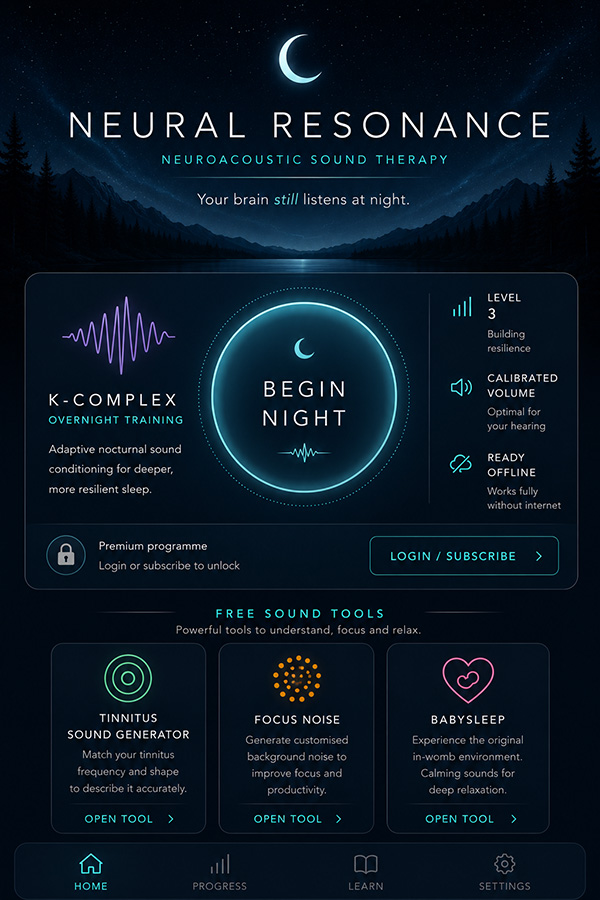
Nocturnal is a project I have been working on alongside Michael Storey. It is a progressive web app — an installable, offline-capable web tool — that plays a carefully ordered, gently varied sequence of overnight sounds intended to support the brain's K-complex response. The aim is to help light sleepers stop being woken by ordinary household noise.
It is not finished. There is no clinical trial behind it. Nothing about it is intended to diagnose, treat or cure anything. This page is an early look at the idea and a way to be notified when it launches.
What is a K-complex?
While you sleep, your brain has to make a constant decision: is that noise a threat, or is it the radiator? A scream, a smoke alarm or a baby crying needs to wake you up. The fridge clicking, a partner turning over, a car passing — those should not.
The K-complex is one of the brain's main mechanisms for that second category. When the sleeping brain hears a non-threatening sound, it can fire a large electrical event — visible on EEG — that briefly suppresses arousal and keeps you asleep. Some people seem to have a generous K-complex response and sleep through almost anything. Others — often new parents who have been training themselves for months to wake at the slightest noise — have a hair-trigger arousal system and a weaker K-complex response, and their sleep stays fragmented long after the baby has left the house.
The research behind the idea
There is a small but growing body of research suggesting that acoustic stimulation delivered during NREM sleep can enhance slow-wave activity and may correlate with next-day cognitive performance. The most cited work used short bursts of pink noise carefully timed to coincide with slow-wave peaks. Other studies have shown that simply playing pink noise overnight can have measurable effects on memory consolidation.
But there are two practical problems with the off-the-shelf solutions:
- REM suppression. Sustained, unchanging sound through the night — including pink noise — appears to reduce dream sleep in some people. That is not a trade-off most people want.
- Habituation. The brain tunes out anything that doesn't change. After roughly ten minutes of the same texture, the K-complex response itself drops off.
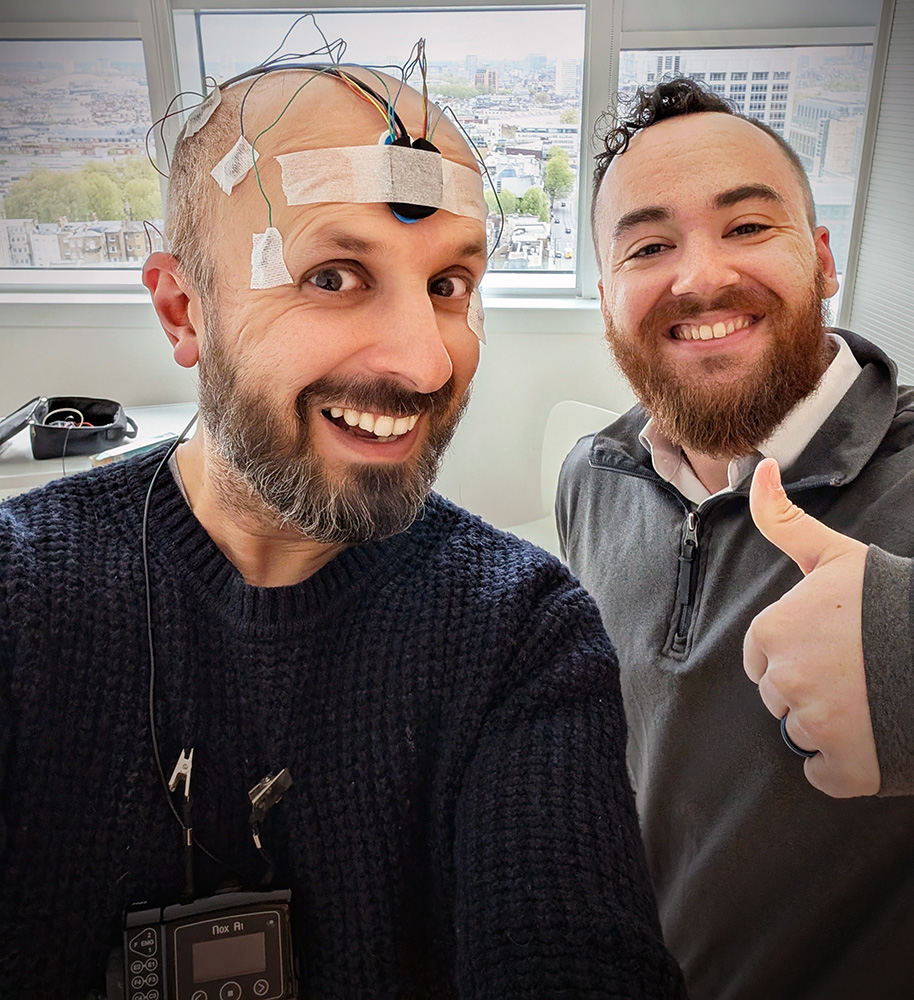
So Michael and I started experimenting on ourselves — EEG montages on our own heads, varying the sounds night after night and looking at what actually changed the K-complex response. What we found is that the sound character has to keep changing. Not randomly — too random and the brain starts treating it as threatening — but in a controlled, organic sequence. Slightly artificial rain, slightly artificial waves, slightly artificial fire crackle, in clusters of a few minutes each, then shifted on. The "slightly artificial" matters: a real recording of waves was less effective than a synthesised version capturing the dominant frequencies of the same sound.
What Nocturnal will do (when it launches)
- Run as an installable PWA — no app store, works offline, works on any phone or tablet
- Play an adaptive overnight sequence of K-complex-supporting sound textures
- Vary the sound on a timed schedule that aims to avoid habituation and protect REM sleep
- Track sessions and a simple personal log so you can see whether you sleep through more household noise over time
- Sit alongside the free Focus Noise, Womb Soundscape and Tinnitus Sound Generator tools
Who I think this is for
- Light sleepers who wake to ordinary household noise — radiators, partners moving, traffic outside
- Parents whose sleep has stayed fragmented long after their children stopped needing them in the night
- People who tolerate pink noise short-term but find it dulls their dream sleep when used continuously
- Anyone curious enough to try a free, browser-based experiment
Important caveats
Nocturnal is a research and education project, not a medical device. It is not intended to diagnose or treat any condition. If you have a sleep disorder — including insomnia, restless legs, or suspected sleep apnoea — please get a clinical assessment rather than relying on an app. If you are pregnant, post-partum, have a hearing problem, or live with a baby or young child, please read the safety guidance we already publish for the Womb Soundscape tool; the same principles apply.
By the time the app launches it will have a clear disclaimer and safety screen. The aim of this page is honesty about where the project sits today — which is exploratory.
When will it launch?
Honestly: when it is good enough. The fastest way to know is to subscribe to the newsletter — I'll send a single email when Nocturnal goes live.
Be notified
Subscribe to receive a single email when Nocturnal launches, plus occasional updates on the rest of the sound-tools work.
Subscribe to the Newsletter →