Written by Professor Vik Veer, Consultant ENT & Sleep Surgeon · Published · Last reviewed
Quick Summary — The Short Version
- Polyps are not a growth to cut out. They are a long-term inflammatory condition of the sinus lining. Removing them without treating the inflammation is mopping the floor with the tap still running.
- 1. Saline rinsing — 240 ml squeeze bottle per side, daily. The base of everything, and nearly free.
- 2. A steroid nasal spray at full polyp dose, twice daily — judged at twelve weeks, not two. Once daily repeatedly fails in trials.
- 3. Steroid nasal drops head-down, or budesonide in the rinse — when the spray is not enough. Escalate the delivery, not the drug.
- 4. A short oral steroid course to reset things — at most once or twice a year, and always followed immediately by topical treatment.
- 5. Surgery — whose real purpose is to open the nose so the rinses can reach where polyps actually grow.
- 6. Biologic injections for severe disease that keeps returning. Dupilumab ranks first across almost every outcome.
- The anatomical fact behind all of it. Irrigation only reliably enters a sinus once the opening is about 4 mm. Natural openings are 1–2 mm, and often closed altogether in a polyp patient.
- Track your own smell. It is the first thing to return on treatment and the first thing to go when polyps come back — often weeks before the nose blocks.
- Red flag. A polyp on one side only is not an ordinary polyp until proven otherwise. It needs a scan and usually a biopsy.
Polyps Are Not a Growth
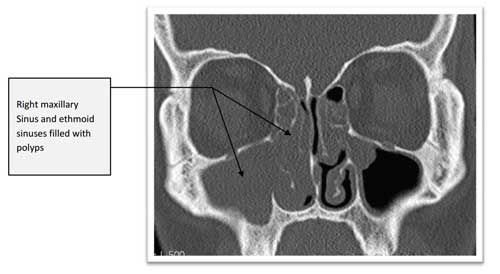
Nasal polyps get described to patients as growths, which sets up the wrong expectation from the first consultation. A growth is something you remove. What is actually happening is that the lining of the sinuses is chronically inflamed and waterlogged, and in places it swells so much that it prolapses out of the sinus openings and hangs down into the nose as a pale, soft, painless sac. The polyp is a symptom of the inflammation, not the disease itself. Removing it without treating the inflammation is like mopping the floor while the tap is still running.
This page covers what the evidence supports for treating them, including the doses, because dose is where most treatment quietly fails. I see a great many patients who have been told their polyps did not respond to a steroid spray, when in reality they used half the dose, once a day instead of twice, for three weeks instead of three months, aimed at the septum, and in a nose so blocked that the spray never got past the front centimetre.
"I saw Vik Veer last week and what a lovely experience. I have suffered from sinus problems for 25 years, with different doctors treating me for hay fever. After examination it was discovered I have a deviated nasal septum, enlarged inferior turbinates and lateral nasal collapse. Vik Veer explained everything in great detail and even drew me diagrams. Nothing was rushed, and he sent me videos on the things we had discussed as promised." Google Review, 5 stars — Shaney Morgan
What Nasal Polyps Are, and How They Are Graded
Polyps arise almost exclusively from the ethmoid sinuses and the middle meatus, which is the narrow channel underneath the middle turbinate where the maxillary, frontal and anterior ethmoid sinuses all drain. They are bilateral in the overwhelming majority of cases. They are insensitive, which is why a polyp can grow large enough to fill a nostril without hurting, and why polyp patients tend to present with blockage and loss of smell rather than pain.
The four symptoms that define the condition are nasal blockage, nasal discharge or postnasal drip, facial pressure, and reduced or absent sense of smell, present for twelve weeks or longer.[38] Loss of smell deserves particular attention, because the olfactory cleft, the narrow slot at the roof of the nose where the smell nerves enter, sits directly in the path of polyp growth. Smell loss is the symptom most reliably associated with the type 2 eosinophilic inflammation that drives most polyp disease in Western populations, and it is usually the first thing to improve on treatment and the first thing to vanish when treatment stops. Patients who monitor their own smell have an early warning system that endoscopy cannot beat. There is more on this on the loss of smell page.
Polyps are graded 0 to 4 on each side and the two are added together, giving a total nasal polyp score of 0 to 8. This is the number used in every biologic trial, so it is worth knowing. A score of 0 means no polyps, 1 means polyps confined to the middle meatus, 2 means they extend below the middle turbinate, 3 means they reach the lower border of the inferior turbinate or are medial to the middle turbinate, and 4 means the nasal cavity is completely obstructed. Trial patients generally start at 5 or 6. Symptom burden is measured with the SNOT-22 questionnaire, scored 0 to 110, where a change of about 9 points is considered the smallest difference a patient would actually notice.
The Central Problem: Polyps Grow Where Sprays Cannot Reach
Everything about treating this condition follows from one anatomical fact. The disease lives in the ethmoid labyrinth and the middle meatus, which sit high and deep in the nose behind a set of narrow bony channels. A standard nasal steroid spray delivers roughly 0.1 millilitres per actuation, propelled forward, and deposits the great majority of that dose in the front portion of the nasal cavity, on the septum and the head of the inferior turbinate. Almost none of it arrives where the polyps are forming.
This is not opinion. Cadaver studies using radio-opaque contrast and CT scanning have shown that pressurised sprays in unoperated sinuses deliver little more than nasal cavity distribution, while squeeze bottle and neti pot irrigation distribute substantially further.[1] Another study using dye in real patients found that sinuses penetrated by irrigation had an average minimum opening of 7.3 mm, whereas sinuses that stayed dry had openings averaging 1.3 mm, and calculated that an opening of about 4 mm is the minimum needed to be confident that fluid gets in.[2] A separate cadaver study found the greatest gain in penetration occurred as openings reached about 4.7 mm.[3] Natural, unoperated sinus openings are typically 1 to 2 mm, and in an inflamed polyp patient they are frequently closed altogether.
Three consequences follow, and they explain most of what appears below. Getting a higher volume of fluid into the nose beats a spray. Getting the head into the right position beats spraying upright. And when neither is enough, the reason for operating is to open the channels rather than to remove the polyps.
Saline Rinsing: The Foundation, and Nearly Free
High volume saline irrigation has consistent evidence behind it, sits in every international guideline as first-line maintenance, and is the only part of the regimen that costs almost nothing. Its job is mechanical. It clears stagnant mucus, crusts and inflammatory debris, restores some mucociliary function, and prepares the surface so that any drug applied afterwards has something to land on rather than a layer of thick mucus.
Use a 240 ml squeeze bottle rather than a small spray or a nebuliser, since douching outperforms both for reaching the maxillary sinus and frontal recess.[4] Make it up with previously boiled and cooled water, or distilled water, and never with water straight from the tap. Lean forward over a sink with the head tilted so the nostril you are rinsing is uppermost, breathe through the mouth, and let it flow out of the other side. Do it before any medicated spray, never after, or you will simply wash the drug out again.
Isotonic saline, which matches the body's own salt concentration, is the standard. Hypertonic saline, which is saltier, draws a little fluid out of the swollen lining by osmosis and gives a mild decongestant effect without any risk of rebound. It stings for the first few days. Either is reasonable, and the one you will actually use daily is the better one.
Steroid Nasal Sprays: The Doses That Appear in the Trials
Topical steroids reduce polyp symptoms with a pooled risk ratio of 1.72 for symptom improvement across twelve randomised trials, and all three of the commonly used molecules, fluticasone, mometasone and budesonide, performed similarly.[5] A Cochrane review comparing steroid types found no convincing evidence that any one molecule is better than another, and no evidence that spray beats aerosol.[6] The brand, in other words, matters far less than people think.
Dosing frequency does matter. Across six randomised trials of conventional sprays, twice daily dosing reduced polyp grade against placebo while once daily dosing generally did not, including in mometasone's own registration studies where the twice daily result replicated and the once daily result did not.[7] A long-term fluticasone study found the same pattern, with twice daily needed to gain control and once daily adequate only afterwards for maintenance.[8] Treating polyps once a day is a common and quiet reason for failure.
| Treatment | Dose in the evidence | Notes |
|---|---|---|
| Mometasone furoate spray | 100 mcg (2 sprays) into each nostril twice daily, total 400 mcg/day | Licensed polyp dose in adults. Reduce to once daily each nostril once controlled. |
| Fluticasone propionate spray | 100 to 200 mcg into each nostril twice daily | 200 mcg twice daily used in the long-term polyp trial; step down to once daily for maintenance. |
| Fluticasone propionate nasal drops | 400 mcg (one single-dose unit) into each nostril twice daily | Twice daily reduced polyp size, once daily did not. Must be taken head-down. |
| Budesonide in saline rinse | 0.5 mg (one 2 ml respule) in 240 ml, once or twice daily. Published range 0.25 to 2 mg per 240 ml | Off-label. Twice daily after surgery or for poorly controlled disease. |
| Oral prednisolone | 25 mg daily for 14 days | Must be followed by topical treatment or the benefit is lost by about week eight. |
| Oral methylprednisolone | 32 mg days 1 to 5, 16 mg days 6 to 10, 8 mg days 11 to 20 | The tapering regimen used in the trial comparing steroids with doxycycline. |
| Doxycycline | 200 mg on day 1, then 100 mg daily, 20 days total | Smaller effect than steroids but it lasted the full 12 weeks of follow-up. |
| Aspirin after desensitisation | 300 mg daily, or 325 to 650 mg twice daily | Only for NSAID-exacerbated respiratory disease. 100 mg daily is not enough for polyps. |
Higher spray doses are not free. In the Cochrane comparison, doubling the dose produced more nosebleeds, with a risk ratio of 2.06, while any additional benefit on polyp score was small enough to be uncertain.[6] Most of that bleeding is streaks of blood in the mucus rather than frank epistaxis, and it is usually a technique problem. Hold the spray in the opposite hand to the nostril, so the right hand sprays the left nostril, which automatically angles the nozzle outwards towards the cheek and away from the septum. Do not sniff hard afterwards, because a sharp sniff carries the drug straight past the nose and down the throat.
Give it twelve weeks before deciding it has failed. Polyps shrink slowly, and in the exhalation delivery trials polyp grade was still improving at week 24.[9]
Steroid Nasal Drops and Head Position
Drops are the neglected middle step between a spray and surgery, and they work because of how they are taken rather than what is in them. Fluticasone propionate nasal drops at 400 mcg twice daily reduced polyp size in placebo-controlled trials, while the same 400 mcg once daily did not, improving only airflow.[10] In a study of 54 patients already on a waiting list for sinus surgery, twelve weeks of fluticasone drops removed the indication for surgery in 13 of 27 patients compared with 6 of 27 on placebo.[11] That is a meaningful number of operations avoided by a formulation change.
The position is the whole point. Lie on your back with your head hanging over the end of the bed so the top of the head points at the floor, or kneel and place the crown of the head on the floor. Put the drops in, stay there for two to five minutes, then come up slowly. Delivery studies of this vertex-to-floor position show consistent arrival of drops in the maxillary sinus, ethmoid cavity, sphenoid and, importantly, the olfactory cleft, with significantly better olfactory cleft coverage at five minutes than at one minute or with an upright spray.[12] Patients dislike it and abandon it quickly, so it is worth explaining why they are being asked to do something undignified.
Betamethasone drops are widely prescribed in the UK and are effective, but they have far greater systemic absorption than fluticasone or budesonide, and I would not use them for months on end without good reason.
Budesonide in Sinus Rinses: How to Do It and What the Evidence Shows
Adding budesonide to a high volume saline rinse combines the best delivery method available outside theatre with a steroid that has very low systemic bioavailability. It is used off-label, which means the drug is licensed but not for this route, and it is worth telling patients that plainly rather than letting them discover it on the leaflet.
The method. Take a 240 ml squeeze bottle, the NeilMed Sinus Rinse type. Fill it with previously boiled and cooled water or distilled water. Add the saline sachet supplied with it. Then open one 2 ml respule of budesonide 0.5 mg, sold as Pulmicort Respules for nebulisers, and empty it into the bottle. Shake it hard immediately before use, because budesonide does not dissolve in water, it only disperses as a suspension, and an unshaken bottle delivers most of the drug in the last few millilitres. Rinse one nostril, then the other. Make it fresh each day.
The dose. One respule, 0.5 mg, in 240 ml is the standard. Two respules, 1 mg, is used for more severe disease or after sinus surgery. Doses across the published literature range from 0.25 mg to 2 mg per 240 ml irrigation, compared with 64 to 400 micrograms per actuation in budesonide spray formulations, and only a small proportion of the irrigated drug is actually retained in the sinuses.[13] Once daily is standard, twice daily after surgery or when control is poor.
The evidence. A randomised double-blind trial in patients who had not had surgery compared budesonide irrigation at 0.5 mg daily against budesonide spray at 512 micrograms daily over twelve weeks. The irrigation group improved their modified Lund-Kennedy endoscopic score by a median of 4 points against 1 point for the spray group. Symptom scores and SNOT-22 did not differ significantly between the two, which is an honest limitation of a 24 patient study, but the objective difference in what happened to the polyps was clear.[14] A systematic review of 23 studies covering 1,182 participants concluded that high volume steroid rinses have a probable positive effect that appears larger in polyp disease than in sinusitis without polyps, while being candid that the study quality does not yet allow firm conclusions.[15]
The safety data. This is the question patients ask and it is a reasonable one, since the dose sounds large. Thirty-five patients using 1 mg budesonide irrigation twice daily for an average of 38 months all had normal morning cortisol levels and no evidence of adrenal suppression on formal testing.[16] A meta-analysis pooling 26 studies and more than 1,400 patients found intraocular pressure and cortisol levels remained normal throughout.[17] One caveat is worth respecting. Patients using a steroid nasal spray, a steroid asthma inhaler and a steroid irrigation simultaneously can accumulate enough total steroid to produce adrenal effects.[18] If you move to budesonide rinses, stop the steroid nasal spray rather than adding one on top of the other, since the rinse makes the spray largely redundant.
The rinse works considerably better after sinus surgery than before it, for the reasons set out above. It is still worth trying in an unoperated nose, as the trial above demonstrates, but expectations should be set accordingly.
Oral Steroids: Fast, Effective, and Not Repeatable
A short oral steroid course is the most reliable way to shrink polyps quickly, and the most reliable way to cause harm if it becomes a habit. In a randomised trial of 60 patients, prednisolone 25 mg daily for two weeks reduced polyp grade by 2.1 units against 0.1 units on placebo, a difference of 1.8 units, and produced a large improvement in smell. Both groups then went onto fluticasone drops at 400 mcg twice daily for eight weeks followed by fluticasone spray. The difference between the groups was still present at 10 weeks but had narrowed to 1.08 units, and by 28 weeks it was 0.8 units and no longer statistically significant.[19] The lesson is that oral steroids buy you a window rather than a cure, and what you do with the window decides the outcome.
That trial also found transient suppression of adrenal function and an increase in bone turnover after two weeks, both of which had returned to baseline by 10 weeks. A single course is generally safe. Repeated courses are how patients end up with cataracts, diabetes, avascular necrosis of the hip and osteoporosis. The conventional ceiling is one to two courses a year, and needing more than that is itself the trigger for considering surgery or a biologic rather than another prescription.
The alternative regimen, from the trial that ran steroids against doxycycline, is methylprednisolone 32 mg on days 1 to 5, 16 mg on days 6 to 10 and 8 mg on days 11 to 20. Its effect peaked at week 3 and had gone by week 8.[20]
Doxycycline: A Genuine Option That Gets Forgotten
In the same randomised, double-blind, placebo-controlled trial of 47 patients with bilateral polyps, doxycycline at 200 mg on day 1 followed by 100 mg daily for a 20 day course significantly reduced polyp size against placebo. The effect was smaller than the steroid arm but it was still present at 12 weeks, whereas the steroid effect had disappeared by week 8.[20] Doxycycline appears to work here by reducing neutrophil-driven inflammation and matrix metalloproteinase activity rather than by killing bacteria, which is consistent with its behaviour in other inflammatory conditions.
This was one trial, in patients with severe disease, either massive polyps or recurrence after surgery, so the results may not generalise to milder cases.[21] A more recent randomised study of long-term low-dose antibiotics added to intranasal steroids found that doxycycline, rather than the macrolides, gave the clearest reduction in polyp stage. It remains a reasonable thing to try in someone who cannot take oral steroids, or who wants something between a spray and an operation.
What Sinus Surgery Is Actually For
Professor Vik Veer's complete guide to sinus disease — what is happening inside the sinuses, what treatment achieves, and when surgery is the right answer.
Functional endoscopic sinus surgery is performed entirely through the nostrils under general anaesthesia, with no cuts on the face and no external bruising. Using a camera and fine instruments, the surgeon removes the polyps that are visible, takes down the thin bony partitions of the ethmoid honeycomb, and widens the natural openings of the maxillary, frontal and sphenoid sinuses.
The important part is what that achieves, and it is not the removal of the polyps. The ethmoid sinuses are a cluster of small air cells separated by paper-thin walls, sitting between the eye sockets, and the middle meatus is the narrow channel beneath the middle turbinate. That is where polyps grow, and it is precisely the region that no spray and, in an unoperated nose, very little rinse fluid ever reaches. Surgery converts that honeycomb into a single open cavity with a wide mouth, so that when the patient rinses afterwards, the steroid solution actually washes over the diseased lining where the polyps originate. The operation is a delivery operation. It makes the medicine work.
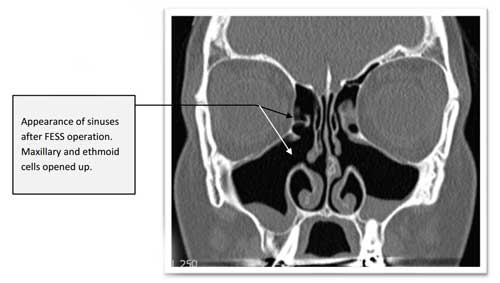
The numbers support that framing directly. Sinus penetration of irrigation is significantly greater after surgery than before it regardless of the delivery device used, and frontal sinus penetration in particular is transformed.[1] Irrigation reliably enters a sinus only once the opening reaches roughly 4 mm, a dimension that natural openings essentially never have in a polyp patient.[2][3] Before surgery, a rinse washes the nasal cavity. After surgery, it washes the sinuses.
This also explains the single most common cause of recurrence, which is stopping treatment after the operation because the nose feels wonderful. It does feel wonderful, for a while. The inflammation that produced the polyps has not gone anywhere, and the surgery has simply created the conditions in which topical treatment can control it. Published recurrence rates after surgery range from about 20 to 80 per cent depending on the population and the length of follow-up, and the patients at the high end are generally those with asthma, aspirin sensitivity, high eosinophil counts and total smell loss.
Surgery should also be kept in proportion against medical treatment. In a multicentre randomised trial of 234 adults, endoscopic sinus surgery combined with ongoing medical therapy improved SNOT-22 at 12 months by 4.9 points more than medical therapy alone, with a confidence interval running from 9.4 to 0.4, which did not reach the trial's own threshold of 9 points for a clinically meaningful difference.[22] That result surprises people, including surgeons. It does not mean surgery is useless, and the patients in that trial were not restricted to those who had exhausted maximal topical treatment. It does mean that offering an operation to someone who has never used a steroid rinse properly is putting things in the wrong order.
There is more detail on the procedure itself, the risks and the recovery on the endoscopic sinus surgery consent page, and the wider picture of the different inflammatory subtypes of sinus disease is covered on the sinusitis page.
"I just wanted to express my heartfelt gratitude for the seamless care I received during my operation. A huge thank you to Dr Veer for his thorough and professional approach. Your kindness, dedication, and expertise truly made a difference — I couldn't have asked for a better experience." Google Review, 5 stars — Ama
Biologic Injections for Severe or Recurrent Polyps
For severe disease that returns despite surgery and topical treatment, monoclonal antibodies that block specific parts of the type 2 inflammatory pathway are now the most effective medical treatment available. They are given by subcutaneous injection, they are expensive, and access is restricted.
- Dupilumab, 300 mg every two weeks. Blocks the shared receptor for interleukins 4 and 13. In the pooled phase 3 trials it improved polyp score by about 2 points against placebo and reduced the need for surgery or oral steroids with a risk ratio of 0.28.[23][24] In a real-world study of 648 patients, median polyp score fell from 6 to 1 over twelve months and median SNOT-22 from 58 to 11.[25] It ranks first across almost every outcome in network meta-analyses.[26]
- Omalizumab. Targets circulating IgE, dosed by body weight and total IgE level. Reduced polyp score by about 1.4 points and lowered the need for surgery.[27]
- Mepolizumab, 100 mg every four weeks. Targets interleukin 5. Improved polyp score by a median of 0.73 points at 52 weeks, and reduced the proportion needing surgery from 37.5 per cent to 25.4 per cent.[28]
- Benralizumab, 30 mg every four weeks for three doses then every eight weeks. Depletes eosinophils directly. Improved polyp score and nasal blockage significantly, though SNOT-22 and time to surgery did not reach significance.[29]
- Tezepelumab, 210 mg every four weeks. Blocks thymic stromal lymphopoietin, which sits further upstream. Reduced polyp score by 2.07 points against placebo at 52 weeks, and surgery was indicated in 0.5 per cent of the treated group against 22.1 per cent on placebo.[30]
- Depemokimab, 100 mg every 26 weeks. An ultra-long-acting anti-interleukin-5 antibody given twice a year. Polyp score improvement was smaller, around 0.7 points against placebo, but the dosing interval is a genuine practical advantage.[31]
Selection criteria matter, because they are the reason many patients are told they do not qualify. The European consensus requires bilateral polyps and previous sinus surgery, or a contraindication to it, plus three of the following five: evidence of type 2 inflammation (tissue eosinophils at 10 per high power field or above, blood eosinophils at 250 cells per microlitre or above, or total IgE of 100 or above), a need for two or more courses of oral steroids per year or long-term steroid use, significantly impaired quality of life with a SNOT-22 of 40 or more, significant loss of smell, and a diagnosis of asthma.[39] Response is formally reviewed at 16 to 24 weeks before treatment continues. Anyone considering a biologic should ask for their blood eosinophil count and total IgE, since those two numbers do much of the deciding.
Aspirin Sensitivity: A Different Disease Hiding in the Same Nose
Roughly one in ten people with difficult polyps have NSAID-exacerbated respiratory disease, the combination of polyps, asthma and reactions to aspirin and ibuprofen, formerly called Samter's triad. This group has the most aggressive polyp disease, the highest recurrence rates after surgery, and a specific treatment that nobody else benefits from.
Aspirin desensitisation involves taking gradually escalating doses of aspirin under medical supervision, usually over one to three days, until the reaction is exhausted, then continuing daily aspirin indefinitely. Dose is critical. A prospective comparison found that patients on 100 mg daily all developed recurrent polyps within a year, while none of those on 300 mg daily did.[32] A randomised comparison of 650 mg twice daily against 325 mg twice daily found both effective, with similar side effect rates, and recommended starting at 650 mg twice daily then reducing to the lowest dose that maintains control.[33] A cohort of 40 patients on 300 mg daily showed significantly fewer sinus infections, steroid courses and operations at both one and three years.[34]
The counter-evidence deserves stating. A 2025 randomised double-blind trial in 26 patients using a target dose of 250 mg daily found no significant difference against placebo in SNOT-22, polyp score or asthma control over eleven months.[35] A 2025 Cochrane review concluded that aspirin treatment after desensitisation may improve quality of life at six months on low-certainty evidence, and that for almost everything else the evidence is inconclusive.[36] Drop-out from gastric side effects is substantial in every series. Dupilumab, incidentally, performs particularly well in this subgroup, with larger improvements than in polyp patients without aspirin sensitivity,[37] so this is increasingly a choice between two treatments rather than a last resort.
Treatments With Weak, Absent or Misunderstood Evidence
Patients arrive having read about a great many things, and the honest answer for most of them is that the evidence is thin.
Montelukast, 10 mg at night. A leukotriene receptor antagonist that can improve nasal symptoms, but it is generally inferior to intranasal steroids and adds little on top of them. It has a place in patients with prominent asthma or aspirin sensitivity, and it is worth knowing that it carries a warning about neuropsychiatric effects including mood change and sleep disturbance.
Antifungal treatment. No meaningful benefit over saline, with the potential for harm. Routine use is discouraged. The fungal hypothesis for polyp disease was attractive and has not survived testing.
Long-term or routine antibiotics. Not supported for chronic use, aside from the specific doxycycline course above and treatment of genuine confirmed infection. Macrolides such as clarithromycin have a reasonable evidence base in sinusitis without polyps and in neutrophilic disease, but they perform poorly in patients with raised IgE, which describes most polyp patients.
Manuka honey rinses. This one comes up often enough to be worth addressing properly, not least because the reasoning behind it is usually wrong. Manuka honey has nothing to do with tea tree oil. The New Zealand manuka plant, Leptospermum scoparium, is colloquially called a tea tree but is a different species from Melaleuca alternifolia, which produces tea tree essential oil. Manuka honey's antibacterial activity comes from methylglyoxal, high osmolarity and low pH, and it does have real activity against staphylococcal and pseudomonal biofilms in the laboratory. Clinically, it has not delivered. A randomised trial of 42 patients found better culture negativity only in a subgroup not on antibiotics or steroids, with SNOT-22 no different from saline, and a meta-analysis of four post-surgical trials found no significant difference in SNOT-22 or endoscopy scores against standard rinses. It is safe at 10 to 16.5 per cent dilution, and it is not better than salt water.
Xylitol, baby shampoo, povidone-iodine and bacteriophage rinses. Early and interesting, evidence base small, nothing strong enough to recommend. A randomised trial of dilute povidone-iodine after sinus surgery found no advantage over normal saline.
Probiotics, proton pump inhibitors and mucolytics. Inconsistent or marginal.
Decongestant sprays. Xylometazoline and oxymetazoline will open a blocked nose, and for a few days during an acute infection that is reasonable. Used continuously, which is what happens when someone has polyps and finds temporary relief, they produce rebound swelling and dependence. There is more on that on the nasal spray addiction page and the blocked nose page.
Putting It Together
A reasonable sequence for an adult with bilateral polyps, assuming nothing sinister on examination, looks like this.[40] Start daily saline rinsing with a 240 ml squeeze bottle and a steroid nasal spray at full dose, two sprays into each nostril twice daily, with the cross-hand technique and no hard sniffing, rinse first and spray afterwards. Review at twelve weeks rather than at three, since polyps shrink slowly.
If the response is partial, escalate the delivery rather than the drug. Move to fluticasone drops at 400 mcg twice daily taken head-down, or to budesonide 0.5 mg added to the daily saline rinse, and stop the spray when you do the latter. If the nose is so blocked that nothing is getting in at all, a two week course of prednisolone at 25 mg daily will open it enough for topical treatment to take hold, and the topical treatment must start immediately rather than after the steroids finish.
If polyps still obstruct the nose after genuinely maximal topical treatment, if smell has not returned, or if oral steroids are needed more than once or twice a year, that is the point at which surgery earns its place, and it should be discussed as a way of opening the sinuses for long-term rinsing rather than as a cure. Rinsing continues afterwards, indefinitely. For those in whom polyps return despite all of this, blood eosinophils and total IgE should be checked and a biologic considered, and anyone with asthma who reacts to aspirin or ibuprofen should be assessed for NSAID-exacerbated respiratory disease specifically.
Loss of smell is worth tracking yourself. It tends to be the first thing that comes back on treatment and the first thing to go when polyps return, often weeks before the nose blocks up again, which gives you time to act rather than react. There is more on smell loss and on olfactory training on the anosmia page.
One last point that sits outside the usual polyp consultation. A nose that is chronically blocked forces mouth breathing at night, which worsens snoring, disturbs sleep and makes CPAP considerably harder to tolerate for anyone who also has obstructive sleep apnoea. Patients frequently report that their sleep improved more than their sinuses did after polyp treatment, and it is a connection I look for routinely. That is covered on the snoring and sleep apnoea page.
References
- Harvey RJ, Goddard JC, Wise SK, Schlosser RJ. Effects of endoscopic sinus surgery and delivery device on cadaver sinus irrigation. Otolaryngology–Head and Neck Surgery. 2008;139(1):137–142.
- Grobler A, Weitzel EK, Buele A, et al. Pre- and postoperative sinus penetration of nasal irrigation. Laryngoscope. 2008;118(11):2078–2081.
- Singhal D, Weitzel EK, Lin E, et al. Effect of head position and surgical dissection on sinus irrigant penetration in cadavers. Laryngoscope. 2010;120(12):2528–2531.
- Wormald PJ, Cain T, Oates L, Hawke L, Wong I. A comparative study of three methods of nasal irrigation. Laryngoscope. 2004;114(12):2224–2227.
- Rudmik L, Schlosser RJ, Smith TL, Soler ZM. Impact of topical nasal steroid therapy on symptoms of nasal polyposis: a meta-analysis. Laryngoscope. 2012;122(7):1431–1437.
- Chong LY, Head K, Hopkins C, Philpott C, Schilder AGM, Burton MJ. Different types of intranasal steroids for chronic rhinosinusitis. Cochrane Database of Systematic Reviews. 2016;4:CD011993.
- Schenkel EJ, Peters AT, Messina JC, Sacks HJ, Mahmoud RA. Evidence for twice-daily nasal steroids versus once daily for treatment of chronic rhinosinusitis with nasal polyps. Journal of Allergy and Clinical Immunology. 2019;143(2):AB279.
- Jankowski R, Klossek JM, Attali V, Coste A, Serrano E. Long-term study of fluticasone propionate aqueous nasal spray in acute and maintenance therapy of nasal polyposis. Allergy. 2009;64(6):944–950.
- Leopold DA, Elkayam D, Messina JC, Kosik-Gonzalez C, Djupesland PG, Mahmoud RA. NAVIGATE II: randomized, double-blind trial of the exhalation delivery system with fluticasone for nasal polyposis. Journal of Allergy and Clinical Immunology. 2019;143(1):126–134.
- Holmström M. Clinical performance of fluticasone propionate nasal drops. Allergy. 1999;54(Suppl 53):21–25.
- Mulder PGH, Fokkens WJ, et al. Treatment of nasal polyposis and chronic rhinosinusitis with fluticasone propionate nasal drops reduces need for sinus surgery. Clinical Otolaryngology. 2005.
- Cannady SB, Batra PS, Citardi MJ, Lanza DC. Comparison of delivery of topical medications to the paranasal sinuses via vertex-to-floor position and atomizer spray after FESS. Otolaryngology–Head and Neck Surgery. 2005;133(2):201–206.
- Cai Y, Bhandari A, Pletcher SD, Loftus PA. Is topical high-volume budesonide sinus irrigation safe? Laryngoscope. 2018;128(6):1269–1270.
- Promsopa C, et al. A randomized, double-blind study comparing corticosteroid irrigations and nasal sprays for polyp size reduction in CRSwNP. Laryngoscope. 2025. doi:10.1002/lary.32250.
- Calvo-Henríquez C, et al. The role of corticosteroid nasal irrigations in the management of chronic rhinosinusitis: a state-of-the-art systematic review. Journal of Clinical Medicine. 2023;12(10):3605.
- Smith KA, French G, Mechor B, Rudmik L. Safety of long-term high-volume sinonasal budesonide irrigations for chronic rhinosinusitis. International Forum of Allergy and Rhinology. 2016;6(3):228–232.
- Magboul N, Mace JC, Rudmik L, Smith TL. Safety of budesonide nasal irrigations: a systematic review and meta-analysis. Rhinology. 2025. doi:10.4193/Rhin24.312.
- Soudry E, Wang J, Vaezeafshar R, Katznelson L, Hwang PH. Safety analysis of long-term budesonide nasal irrigations in patients with chronic rhinosinusitis post endoscopic sinus surgery. International Forum of Allergy and Rhinology. 2016;6(6):568–572.
- Vaidyanathan S, Barnes M, Williamson P, Hopkinson P, Donnan PT, Lipworth B. Treatment of chronic rhinosinusitis with nasal polyposis with oral steroids followed by topical steroids: a randomized trial. Annals of Internal Medicine. 2011;154(5):293–302.
- Van Zele T, Gevaert P, Holtappels G, et al. Oral steroids and doxycycline: two different approaches to treat nasal polyps. Journal of Allergy and Clinical Immunology. 2010;125(5):1069–1076.
- Grammer LC. Doxycycline or oral corticosteroids for nasal polyps. Journal of Allergy and Clinical Immunology: In Practice. 2013;1(4):380–381.
- Lourijsen ES, Reitsma S, Vleming M, et al. Endoscopic sinus surgery with medical therapy versus medical therapy for chronic rhinosinusitis with nasal polyps: a multicentre, randomised, controlled trial. Lancet Respiratory Medicine. 2022;10(4):337–346.
- Bachert C, Han JK, Desrosiers M, et al. Efficacy and safety of dupilumab in patients with severe chronic rhinosinusitis with nasal polyps (LIBERTY NP SINUS-24 and SINUS-52). Lancet. 2019;394(10209):1638–1650.
- Agache I, Song Y, Alonso-Coello P, et al. Efficacy and safety of treatment with biologicals for severe chronic rhinosinusitis with nasal polyps: a systematic review for the EAACI guidelines. Allergy. 2021;76(8):2337–2353.
- De Corso E, Pasquini E, Trimarchi M, et al. Dupilumab in the treatment of severe uncontrolled chronic rhinosinusitis with nasal polyps: a multicentric observational phase IV real-life study (DUPIREAL). Allergy. 2023;78(10):2669–2683.
- Oykhman P, Paramo FA, Bousquet J, Kennedy DW, Brignardello-Petersen R, Chu DK. Comparative efficacy and safety of monoclonal antibodies and aspirin desensitization for chronic rhinosinusitis with nasal polyposis: a systematic review and network meta-analysis. Journal of Allergy and Clinical Immunology. 2022;149(4):1286–1295.
- Gevaert P, Omachi TA, Corren J, et al. Efficacy and safety of omalizumab in nasal polyposis: two randomized phase III trials. Journal of Allergy and Clinical Immunology. 2020;146(3):595–605.
- Han JK, Bachert C, Fokkens W, et al. Mepolizumab for chronic rhinosinusitis with nasal polyps (SYNAPSE): a randomised, double-blind, placebo-controlled, phase 3 trial. Lancet Respiratory Medicine. 2021;9(10):1141–1153.
- Bachert C, Han JK, Desrosiers M, et al. Efficacy and safety of benralizumab in chronic rhinosinusitis with nasal polyps: a randomized, placebo-controlled trial (OSTRO). Journal of Allergy and Clinical Immunology. 2022;149(4):1309–1317.
- Lipworth B, Han JK, Desrosiers M, et al. Tezepelumab in adults with severe chronic rhinosinusitis with nasal polyps. New England Journal of Medicine. 2025. doi:10.1056/NEJMoa2414482.
- Gevaert P, et al. Efficacy and safety of twice per year depemokimab in chronic rhinosinusitis with nasal polyps (ANCHOR-1 and ANCHOR-2). Lancet. 2025. doi:10.1016/S0140-6736(25)00197-7.
- Rozsasi A, Polzehl D, Deutschle T, et al. Long-term treatment with aspirin desensitization: a prospective clinical trial comparing 100 and 300 mg aspirin daily. Allergy. 2008;63(9):1228–1234.
- Lee JY, Simon RA, Stevenson DD. Selection of aspirin dosages for aspirin desensitization treatment in patients with aspirin-exacerbated respiratory disease. Journal of Allergy and Clinical Immunology. 2007;119(1):157–164.
- Comert S, Celebioglu E, Yucel T, et al. Aspirin 300 mg/day is effective for treating aspirin-exacerbated respiratory disease. Allergy. 2013;68(11):1443–1451.
- Lyly A, Salmi V, Mäkelä M, et al. Efficacy of aspirin therapy after desensitization on chronic rhinosinusitis with nasal polyps patients with asthma and N-ERD: a randomized clinical trial. Allergy. 2025;80(12):3151–3164.
- Lourijsen E, Avdeeva K, Gan KL, Fokkens W. Oral and intranasal aspirin desensitisation for NSAID-exacerbated respiratory disease. Cochrane Database of Systematic Reviews. 2025;1:CD013476.
- Mullol J, Laidlaw TM, Bachert C, et al. Efficacy and safety of dupilumab in patients with uncontrolled severe CRSwNP and a clinical diagnosis of NSAID-ERD. Allergy. 2022;77(4):1231–1244.
- Fokkens WJ, Lund VJ, Hopkins C, et al. European Position Paper on Rhinosinusitis and Nasal Polyps 2020. Rhinology. 2020;58(Suppl S29):1–464.
- Fokkens WJ, Viskens AS, Backer V, et al. EPOS/EUFOREA update on indication and evaluation of biologics in chronic rhinosinusitis with nasal polyps 2023. Rhinology. 2023;61(3):194–202.
- Staricha KL, Ali HM, Stokken JK. State of the art medical management of nasal polyps. American Journal of Rhinology & Allergy. 2023;37(2):153–161.
Contact Professor Vik Veer
If you would like to know more about treating nasal polyps or to arrange a consultation, please use the details below.
Private secretary: 0207 458 4584
Email: secretary@consultant-surgeon.co.uk
Page created 20th September 2026 by Professor Vik Veer, Consultant ENT & Sleep Surgeon, 150 Harley Street, London. This page is patient education and does not replace individual medical assessment. The doses given are those used in the published evidence and are included so that you can discuss them with your own doctor — do not start, stop or change any medication on the basis of a web page. Budesonide sinus irrigation is an off-label use. Patient comments are genuine published reviews; individual results vary.