Written by Professor Vik Veer, Consultant ENT & Sleep Surgeon · Published · Last reviewed
Quick Summary
- Wax is normal and protective. It is slightly acidic, antimicrobial, and carried out of the ear by migrating skin cells. Wax that causes no symptoms and does not hide the eardrum should not be routinely treated.[3][4]
- Symptoms of impaction. Reduced hearing, tinnitus, itch, pain and dizziness.[1][2]
- Never use cotton buds, hair pins or ear candles. They push wax deeper, injure the clearing mechanism and cause burns. See causes and risk factors.
- Softening drops. The evidence for any one drop is weak.[1] My preference for home use is water-based: sterile steam-distilled water, or sodium bicarbonate with care. I do not recommend oil or hydrogen peroxide at home. See softening agents.
- Removal. Microsuction under a microscope is my preferred method. Irrigation works for many people but carries a recognised risk of perforation and is not suitable for everyone.
- Prevention. Stop cotton buds, and have periodic review if you make wax quickly or wear hearing aids or ear moulds.
Watch first. This is my original, longer video on ear wax and which ear drops work best. Watch it here, then read the written guide below.
What Is Ear Wax?
What ear wax is made of, and where it is made
Ear wax, known medically as cerumen, is a natural, protective substance made by the skin that lines your ear canal. It is produced in the outer part of the canal, the part nearest the opening, where the skin contains tiny oil-producing glands (sebaceous glands) and modified sweat glands called ceruminous glands. The deeper part of the canal, nearer the eardrum, has thin skin and makes almost no wax of its own.
Ear wax is not simply oil. It is a mixture of the sticky, fatty secretions from those glands, together with dead skin cells (made of a tough protein called keratin), tiny hairs, dust and other debris that has drifted into the ear. The fatty part includes substances such as fatty acids, squalene and cholesterol, and it also contains natural antibacterial proteins. The result is a thick, sticky, waxy coating that varies in colour and texture from person to person, from pale and dry and flaky to dark and soft and sticky.
A travelator for wax: how the ear cleans itself
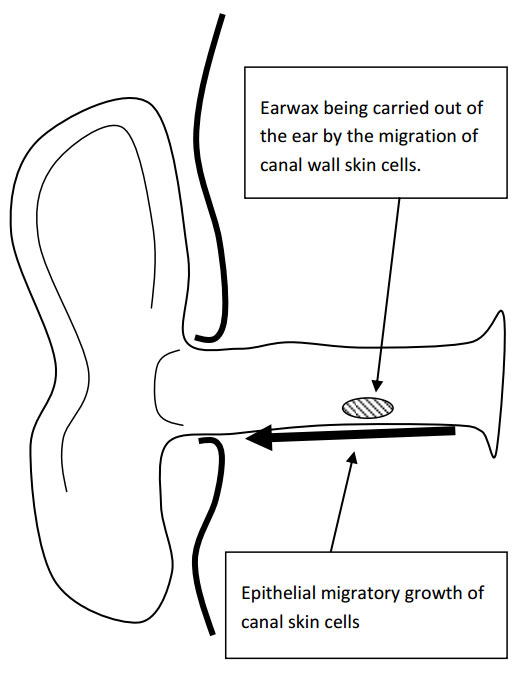
The ear canal is a self-cleaning system, and it works a little like a moving walkway (a travelator) in an airport. The skin lining the ear canal, and the outer layer of the eardrum itself, is constantly growing and moving outwards. New skin cells are made near the centre of the eardrum, and the whole sheet of skin slowly travels across the drum and then out along the walls of the canal towards the opening of the ear. This process is called epithelial migration. It is slow, at roughly the speed at which a fingernail grows, but it never stops.
Ear wax sits on top of this moving skin, like luggage riding on a travelator. As the skin moves, the wax is carried out of the ear with it, and it takes dust, dead skin, dirt and anything else that has landed in the canal along for the ride. Movement of the jaw when you chew and talk helps to loosen the wax and keep it moving. When the wax reaches the outer part of the ear it dries, flakes off and falls away, or is washed off when you wash your face and hair. You never notice it happening.
The same slow movement spreads the wax out into a very thin layer that coats the whole length of the canal. That thin coating is what makes it so useful.
Why you have ear wax
Ear wax is a low-acidity (low pH), sticky substance, and it does three jobs at once. First, it is slightly acidic, in the same way the skin elsewhere on the body has a thin acidic coat. This is much milder than stomach acid, but it is enough to stop bacteria and fungi growing in the canal. Second, it is sticky, so it traps dust, dirt, dead skin and small insects, and then drags that debris out of the ear on the travelator. Third, it waterproofs and lubricates the skin of the canal, preventing it from drying out and becoming itchy or cracked. In other words, a healthy ear canal is meant to have some wax in it, and in most people it looks after itself without any help.
When wax becomes a problem
Problems start when wax builds up faster than the travelator can remove it, when the travelator itself stops working properly (for example after an ear infection), or when wax is pushed back in again. This build-up is called impaction. It is a common reason for visits to the GP. When impacted wax blocks the canal it can cause reduced hearing, a feeling of fullness, ringing in the ear (tinnitus), itch, pain and sometimes dizziness [1][2].
The key decisions are whether the wax actually needs to be removed, how to remove it safely for the individual patient, and how to deal with the cause so that it does not keep coming back. This page sets out how I approach each of these, and where the evidence is strong or weak.
Definition and when to treat
Cerumen impaction is defined as an accumulation of cerumen that causes symptoms, prevents assessment of the ear, or both. Asymptomatic wax that does not obscure the view of the tympanic membrane should not be routinely treated [3][4]. Patients who cannot express symptoms, including young children and cognitively impaired adults, should be identified early, because they often present with behavioural change or with a wax plug discovered incidentally [3].
Causes and risk factors
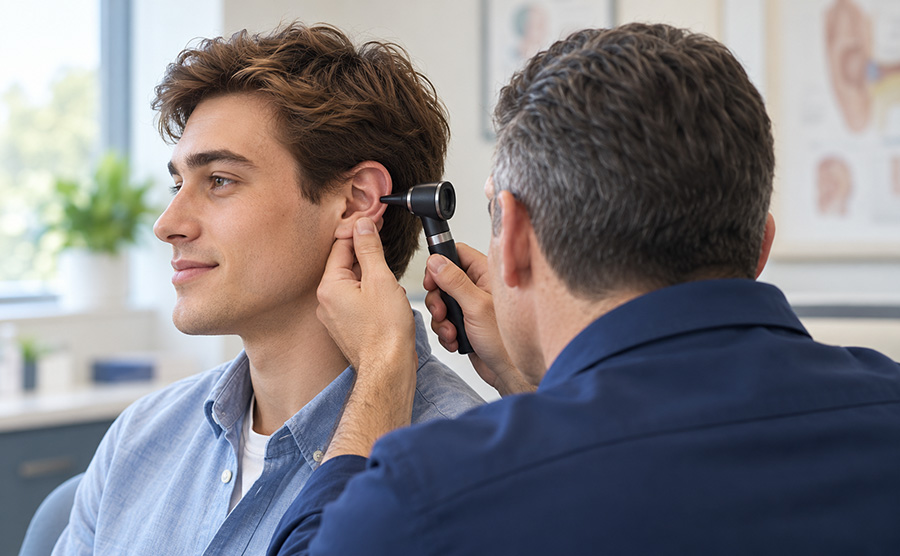
The most important modifiable cause is mechanical. Cotton buds and hair pins push wax deeper into the canal, and they injure the migratory epithelium. Repeated scratching produces itch as the skin regrows, which in turn encourages further scratching and further wax retention. Ear candles are not an alternative and are associated with burns; the American guideline recommends against them [3]. Other causes include hearing aids and ear moulds, which trap wax against the canal wall; narrow, exostotic or stenotic canals; dermatological conditions of the canal; and reduced cerumen clearance in older people [3][5].
Factors that modify management should be identified before any intervention: anticoagulant therapy, immunocompromise, diabetes, prior head and neck radiotherapy, canal stenosis, exostoses, and a non-intact tympanic membrane [3]. A history of grommets, prior ear surgery or a mastoid cavity changes the choice of technique, and it should be recorded.
"Mr Veer was excellent! He explained everything clearly in an unhurried and calm manner and really put me at ease whilst telling me what was required." Google Review, 5 stars — Steven Angeli
Softening Agents
Softening agents are the first step for most patients with an uncomplicated wax plug, and they help to loosen wax so that it can be removed by irrigation or microsuction. The principal classes are oil-based agents (olive oil, almond oil, mineral oil), water-based agents (water, saline, sodium bicarbonate), and other preparations such as carbamide peroxide and glycerol-based products [1].
The experiment. In this shorter, updated video I put ear wax into test tubes with five different drops, to see which dissolves it best.
The evidence for softening agents is weaker than many clinicians assume. The 2018 Cochrane review of ear drops found ten randomised trials, most of them more than 15 years old, and rated the evidence for every comparison as low or very low quality [1]. Drops were more effective than no treatment in the single study that addressed this comparison, but there was no evidence that any one active agent was superior to another, and no evidence of a difference between oil-based and water-based treatments [1]. Likewise, the 2010 Health Technology Assessment reported that sodium bicarbonate, olive oil and water were all more effective than no treatment, and that the best-quality data did not allow a firm ranking [2].
Laboratory and animal data are more directional. In a comparison of cerumenolytic properties, water was significantly more effective than the other products tested, including docusate and mineral oil [6]. Oil-based agents have been studied in animals with perforated tympanic membranes, and olive and almond oil did not produce measurable hearing loss or hair cell damage in chinchillas [7][8]. Docusate sodium, by contrast, was ototoxic in the same guinea-pig model and should be avoided [6]. These findings shape the safety discussion, but they are animal data and do not establish clinical efficacy.

My position. Water-based drops are my preferred softening agent for home use. Sterile, steam-distilled water is suitable because its pH is close to that of the ear canal and it dissolves wax well. Sodium bicarbonate is an effective alternative, but its alkaline pH can irritate the skin of the canal and cause itch, so I use it with caution and stop it if itch develops. I do not recommend oil-based drops for home use. Where oil is used at all, it is only to soften wax in preparation for specialist microsuction, under clinical direction.
How to use ear drops. Technique matters as much as the choice of drop. This video shows how to use them properly and how to avoid the risks.
Hydrogen peroxide preparations are effective at dissolving wax, and some patients have used them without apparent problems. My reservation is theoretical rather than evidence-based: I am concerned about the generation of reactive oxygen species in the middle ear if the tympanic membrane is perforated, and about the rare possibility of hearing change. I am not aware of clinical data demonstrating harm at the concentrations commonly used, and the evidence for this concern is limited. For that reason I do not recommend it as a first-line home treatment, and I would not use it in a patient with a known or suspected perforation.
Removal Techniques
Microsuction. This is my preferred removal method. A fine suction device is used under binocular microscope vision, and no water is introduced into the canal. It allows direct inspection of the tympanic membrane during the procedure, which is the safest reliable way of dewaxing an ear [5]. Aural microsuction is the most commonly used method of wax removal in ENT clinics [9]. Patients usually experience immediate relief from deafness, pressure and pain. Microsuction is also useful after mastoid surgery, where regular removal of wax and keratin prevents impaction in the bony defect [9].
Irrigation (syringing). Irrigation is still widely used in primary care and is effective in many patients. It works by introducing warm water behind the wax so that it is pushed outwards. This is also its principal weakness: a complete occlusion can be driven against the tympanic membrane, and a pre-existing abnormality of the membrane can be damaged [5]. A survey of general practitioners reported complications in 38% of practitioners, including perforation and canal laceration, and estimated complications requiring specialist referral at around one in 1,000 ears syringed [10]. Irrigation should be avoided in patients with a known or suspected perforation, prior grommets or ear surgery, a discharging ear, or other contraindications listed above [3][5]. Where irrigation is used, it should be performed with a controlled-pressure device and by a trained operator, and the ear should be re-examined afterwards [3].
Manual removal with instruments. Otoendoscopic removal is possible but requires training, because the view is monocular and the instruments are small. A binocular microscope with suction and micro-instruments is probably the safest method, though it is expensive and requires training [5].
Choice of method should be individualised. My general approach is to soften first with water-based drops where appropriate, then to use microsuction for persistent impaction, with irrigation reserved for patients in whom it is clearly safe and where the operator is confident.

Assessment of the ear after treatment
The ear should be examined after treatment and the resolution of impaction documented. If the impaction is not resolved, further treatment is required. If symptoms persist despite a clear canal, alternative diagnoses should be considered, including sensorineural or conductive hearing loss, middle ear disease, tinnitus from other causes, and vestibular disorders [3].
Prevention and recurrence
Recurrent wax is common, and the most useful measures are to stop cotton buds, to avoid pushing objects into the canal, and to have periodic review for patients who produce wax quickly or wear hearing aids or ear moulds. Hearing aid users should have their ears examined for wax during routine follow-up, and where wax recurs repeatedly, periodic microsuction may be more effective than attempting to manage the problem at home [3]. Patients with narrow canals or exostoses may benefit from specialist advice about canal management.
Recurrent Wax and Narrow Canals
To avoid ear wax building up again and causing problems requires more experience, and repeated microsuction on its own is normally not enough. I can explain the treatments available to stop ear wax becoming a lifelong problem. The vast majority of patients can be treated without surgery.
In cases where the ear canal is naturally narrow and prone to recurrent blockages, surgical options are available to create more space within the ear canal. These operations aim to widen the canal, reducing the likelihood of future blockages and making it easier for earwax to exit the ear naturally. Consultation with an ENT specialist is essential to determine the most appropriate treatment plan based on individual needs.
I teach nurses and other doctors how to remove ear wax correctly, and I have developed courses to teach the microsuction technique properly.
"An excellent consultation — I felt Mr Veer listened to me and treated me as an individual. It helped me feel that taking responsibility for my condition was reasonable and that we could move forward in a practical way together." Google Review, 5 stars — Hilary Martin
Summary
- Wax is protective, and symptomatic impaction should be treated, but asymptomatic wax with a visible tympanic membrane does not need removal.
- Cotton buds, hair pins and ear candles are harmful and should be avoided.
- Water-based softening drops are my preferred first step. Sterile, steam-distilled water is suitable, and sodium bicarbonate is an effective alternative that may itch.
- Oil-based drops are not recommended for home use. Where oil is used, it is only to prepare the ear for microsuction.
- Hydrogen peroxide is effective, but I reserve it from home use because of a theoretical concern about perforated ears.
- Microsuction under microscopic vision is the preferred removal method. Irrigation is effective but carries a recognised risk of perforation and should be avoided where contraindicated.
Frequently Asked Questions
Yes. Ear wax (cerumen) is a normal, protective secretion of the ear canal. It is slightly acidic, has antimicrobial properties, and is moved slowly outwards by the migration of skin cells on the canal wall. It only needs treatment when it causes symptoms or prevents the eardrum from being examined.
Reduced hearing, a feeling of fullness, tinnitus, itch, pain and sometimes dizziness. Young children and adults who cannot describe their symptoms may instead show a change in behaviour, or the wax plug may be found incidentally.
Cotton buds and hair pins push wax deeper and injure the migrating skin cells that clear the canal. Scratching also causes itch as the skin regrows, which encourages more scratching and more wax retention. Ear candles are associated with burns and are not recommended.
The evidence is weaker than many people assume: a 2018 Cochrane review found no evidence that any one drop was better than another, and rated all comparisons as low or very low quality. Professor Veer prefers water-based drops for home use. Sterile, steam-distilled water is suitable, and sodium bicarbonate is an effective alternative that can irritate the canal and cause itch. He does not recommend oil-based drops or hydrogen peroxide for home use.
Irrigation is effective in many people but is not risk-free. It can drive a complete plug against the eardrum and can damage an abnormal membrane. A survey of GPs reported complications in 38% of practitioners, including perforation and canal laceration, and estimated around one complication needing specialist referral for every 1,000 ears syringed. It should be avoided if you have a known or suspected perforation, grommets, previous ear surgery or a discharging ear.
Microsuction uses a fine suction device under binocular microscope vision, with no water introduced into the canal. It allows the eardrum to be inspected during the procedure and is the safest reliable way of removing wax. Most people notice immediate relief from deafness, pressure and pain.
See a specialist if drops have not helped, if you have pain, discharge, sudden hearing loss or dizziness, if you have a known or suspected perforation, grommets or a mastoid cavity, if you take anticoagulants or have diabetes or a weakened immune system, or if your symptoms persist after the wax has been cleared.
Stop using cotton buds and avoid pushing anything into the ear. If you make wax quickly, or wear hearing aids or ear moulds, periodic review and microsuction is often more effective than managing it at home. People with narrow canals or exostoses may benefit from specialist advice, and in selected cases surgery to widen the canal is possible.
References
- Aaron K, et al. Ear drops for the removal of ear wax. Cochrane Database Syst Rev. 2018;CD012171. doi:10.1002/14651858.CD012171.pub2
- Clegg A, Loveman E, Gospodarevskaya E, et al. The safety and effectiveness of different methods of earwax removal: a systematic review and economic evaluation. Health Technol Assess. 2010;14(28). doi:10.3310/hta14280
- Schwartz SR, et al. Clinical practice guideline (update): earwax (cerumen impaction). Otolaryngol Head Neck Surg. 2017. doi:10.1177/0194599816671491
- Roland PS, et al. Clinical practice guideline: cerumen impaction. Otolaryngol Head Neck Surg. 2008. doi:10.1016/j.otohns.2008.06.026
- Wright T. Ear wax. BMJ. 2015. doi:10.1136/bmj.h3601
- Nader ME, et al. Ototoxicity of intratympanic docusate sodium and mineral oil in the guinea pig. Otolaryngol Head Neck Surg. 2012. doi:10.1177/0194599811429255 (Animal study.)
- Peleva E, et al. Assessment of the ototoxicity of almond oil in a chinchilla animal model. Laryngoscope. 2011. doi:10.1002/lary.22385 (Animal study.)
- Emami N, et al. Ototoxicity of olive oil in a chinchilla animal model. Laryngoscope. 2013. doi:10.1002/lary.24041 (Animal study.)
- Sarode D, et al. Aural microsuction. BMJ. 2017. doi:10.1136/bmj.j2908
- Sharp J, et al. Ear wax removal: a survey of current practice. BMJ. 1990;301:1251. doi:10.1136/bmj.301.6763.1251
Further reading: Munro K, et al. Ear wax management in primary care: what the busy GP needs to know. Br J Gen Pract. 2023. doi:10.3399/bjgp23x732009
This page was updated on 29th October 2026 and is for general information. It does not replace assessment by a doctor. If you have ear pain, discharge, sudden hearing loss or dizziness, please seek medical review.